Views: 0 Author: Site Editor Publish Time: 2026-03-20 Origin: Site
Polycrystalline Diamond Dies are key to high-precision wire drawing, cutting, and drilling. This guide explains PCD materials, die selection, and installation tips to boost performance. Learn how grain size, geometry, and proper handling improve durability, reduce scrap, and increase throughput. NJ-ModernDiamond Co., Ltd. provides top-quality PCD dies for reliable, long-lasting results in copper, aluminum, and specialty alloys.
Polycrystalline Diamond, or PCD, is an engineered material made by fusing tiny diamond crystals under extreme pressure and heat. They use high-pressure, high-temperature (HPHT) processes to create a dense, uniform composite. Essentially, microscopic diamonds are bonded onto a hard substrate like tungsten carbide, forming a material that is much tougher than a single natural diamond. Unlike natural diamonds, PCD is man-made, which allows manufacturers to control hardness, grain size, and thermal properties. They can tailor it for wire drawing, cutting, or drilling tasks.
Microscopic diamond crystals fused into a solid block
Usually bonded to carbide or alternative substrates for support
Engineered for consistency, unlike natural diamond
PCD’s appeal comes from its unique combination of extreme hardness and durability. Here’s what makes it stand out:
Hardness: Ranges from 7,000–9,000 HV (Vickers), far harder than tungsten carbide (~1,800 HV)
Wear Resistance: Extremely resistant to abrasion, even at high speeds
Thermal Conductivity: ~500 W/m·K, keeps it cool during fast operations
Fracture Toughness: Handles mechanical shock better than conventional diamond tools
| Property | PCD | Tungsten Carbide | Natural Diamond |
|---|---|---|---|
| Hardness (HV) | 7,000–9,000 | ~1,800 | 10,000 |
| Wear Resistance | Exceptional | Moderate | High |
| Thermal Conductivity | ~500 W/m·K | ~110 W/m·K | ~220 W/m·K |
| Fracture Toughness | 7–12 MPa·m⁰·⁵ | 4–6 MPa·m⁰·⁵ | 3–5 MPa·m⁰·⁵ |
Not all PCD is the same. Its performance depends on grain size, binder type, and comparison to similar materials.
Grain Size
Fine (2–10 µm): Smooth surfaces, tight tolerances
Medium (10–20 µm): Balance of toughness and precision
Coarse (20–50 µm): Maximum wear resistance, ideal for hard metals
Binder Materials
Cobalt: Tough, common, may degrade above 700°C
Ceramic: Higher thermal stability, ideal for high-speed cutting
Silicon: Often used for extreme abrasion environments
PCD vs. PCBN
PCD works best on non-ferrous metals, composites, and abrasive materials
PCBN (polycrystalline cubic boron nitride) excels on ferrous metals and high-temperature steels
They are similar in structure but optimized for different applications
Selecting the right PCD variation can boost die life, reduce friction, and improve surface finish.
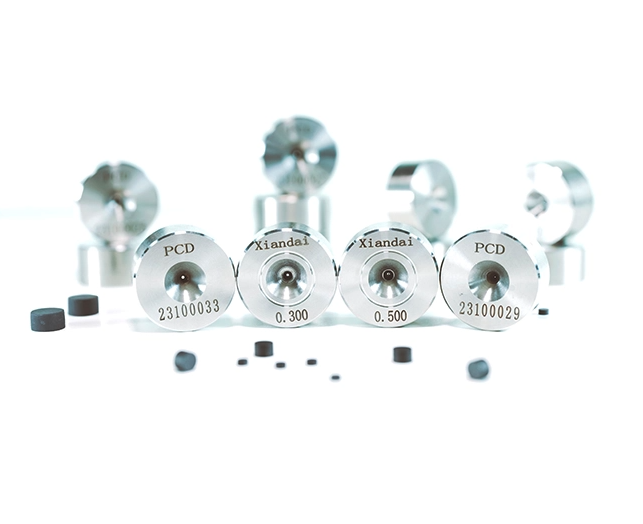
Choosing the right PCD die can make a huge difference in performance and tool life. Here are the key factors to evaluate:
Material to Be Processed
They excel on non-ferrous metals, composites, ceramics. Ferrous metals at high temperatures can cause carbon diffusion and tool wear. Always match the die to the material.
Die Shape and Geometry
Shapes like conical, elliptical, or multi-radius affect how material flows and the surface finish. Longer approach angles reduce friction. Proper bearing lands ensure consistent wire diameter.
Operating Conditions
Speed, temperature, and lubrication all impact die life. High-speed or high-pressure operations need adequate cooling to prevent thermal shock. Dry or poorly lubricated setups require tougher die variants.
Consider both immediate performance and long-term reliability. A die optimized for one material or speed may underperform elsewhere.
Diamond Grain Size Selection
Fine grains give smooth finishes, medium balances wear and precision, coarse maximizes durability for abrasive materials.
Substrate and Binder Considerations
Tungsten carbide substrates provide support. Cobalt binders offer toughness, ceramic or silicon binders improve thermal resistance.
Surface Finish Requirements
Mirror-polished die bores reduce friction and improve wire roundness. Polished surfaces reduce scrap and downtime.
Cost vs. Performance Analysis
High-quality dies cost more upfront but last longer, reduce downtime, and minimize scrap. Always weigh total cost per part.
Supplier Expertise and Certifications
Work with manufacturers offering ISO certifications and technical support. Custom designs and proven quality control enhance reliability.
| Factor | Recommendation | Notes |
|---|---|---|
| Material | Non-ferrous metals, composites, ceramics | Avoid ferrous at high temps |
| Shape & Geometry | Conical, elliptical, multi-radius | Match reduction ratio & surface finish |
| Operating Conditions | Proper cooling, speed management | Prevent thermal damage |
| Grain Size | Fine, medium, coarse | Choose based on finish vs. wear |
| Substrate/Binder | Carbide with cobalt, ceramic, or silicon | Check thermal and mechanical compatibility |
| Surface Finish | Mirror-polished bore | Reduces friction, improves consistency |
| Supplier Expertise | ISO-certified, technical support | Custom solutions enhance performance |
In wire and cable production, PCD dies are essential for creating high-performance wires. They can handle high-tensile steel, copper, aluminum, and specialty alloys while maintaining uniform roundness and smooth surface finishes. Using PCD dies reduces the frequency of die changes and scrap pieces, allowing manufacturers to achieve higher throughput and consistent quality, which ultimately saves both time and costs.
The aerospace and automotive industries rely on PCD dies for machining high-strength materials such as titanium, carbon-fiber composites, and nickel-based superalloys. These tools help maintain sharp edges and precise dimensions while reducing scrap rates. PCD dies enable fast, repeatable machining of critical components, including turbine blades, engine parts, and lightweight structural elements, ensuring both precision and reliability in demanding applications.
In the electronics and 3C sectors, micron-level precision is critical. PCD dies excel at machining silicon wafers, ceramics, sapphire glass, and other brittle materials. They provide ultra-smooth finishes, support micro-precision machining, and meet zero-defect production requirements. This makes them ideal for high-volume manufacturing of semiconductors, optical components, and consumer electronics, where accuracy and surface quality are paramount.
PDC compacts are widely used in oil, gas, and mining operations, where extreme drilling conditions demand durable tools. These dies handle deep-hole drilling, geothermal exploration, and hard rock mining while providing exceptional abrasion resistance and stability at high rotational speeds. By using PCD compacts, operators can improve penetration rates, reduce downtime, and extend the life of drill bits, resulting in more efficient and cost-effective extraction processes.
| Industry | Materials / Components | Key Benefits |
|---|---|---|
| Wire & Cable | Steel, Copper, Aluminum | Smooth surface, uniform roundness, fewer die changes |
| Aerospace & Automotive | Titanium, Composites, Superalloys | Precision, edge retention, reduced scrap |
| Electronics & 3C | Silicon, Ceramics, Sapphire Glass | Micro-precision, zero-defect production |
| Oil & Gas / Mining | Rock, Hard Minerals | Abrasion resistance, high-speed stability |

Installing a PCD wire drawing die properly is crucial for consistent wire quality.
Alignment, Lubrication, and Tension Control
Make sure the die aligns perfectly in the die box. Misalignment causes uneven wear or wire breakage. Use appropriate lubricants, oil or soap-based, to reduce friction. Maintain consistent tension to prevent lateral stress on the die.
Multi-Stage Drawing Process Tips
Gradually reduce wire diameter across multiple dies. Avoid large single-pass reductions to prevent wire cracking. Ensure each die stage has proper lubrication and alignment to maintain smooth metal flow.
PCD inserts and tools require careful mounting to maximize life.
Proper Mounting in CNC Tool Holders
Secure the insert in a compatible holder using the recommended clamping method. Check torque specifications to prevent vibration.
Coolant Flow and Vibration Management
Provide consistent coolant to reduce heat and flush swarf. Minimize interrupted cuts, as shocks increase stress on the diamond layer.
Polycrystalline Diamond Compacts (PDCs) are commonly used in drill bits for mining and oil exploration.
Mounting on Drill Bits
Attach compacts using brazing or mechanical retention systems. Ensure they are seated securely to resist torque and vibration during drilling.
Bonding and Orientation for Optimal Performance
Align cutting faces according to the drill’s rotation. Proper orientation improves rock penetration, reduces wear, and extends tool life.
| Die Type | Key Steps | Common Tips |
|---|---|---|
| Wire Drawing Die | Alignment, tension, lubrication | Use multi-stage drawing for high reduction |
| PCD Cutting Tool | Secure clamping, coolant management | Avoid interrupted cuts, check vibration |
| PDC Compacts | Mounting, bonding, rotation alignment | Inspect for micro-cracks before deployment |
Regular inspection is essential to keep PCD dies performing at their best. We recommend visual and microscopic checks to spot wear, micro-chipping, or surface irregularities before they affect production. Tracking die lifespan and performance over time helps predict when replacement or maintenance is needed, preventing unexpected downtime. Using a logbook or digital tracking system can make it easier to monitor usage hours and detect early signs of uneven wear.
Cleaning PCD dies properly preserves their hardness and smooth surface. Use soft brushes and mild, non-abrasive solvents to remove metal particles or residues. Avoid ultrasonic cleaners or harsh abrasive tools, as they can chip or scratch the diamond layer. Compressed air can help dry the die after cleaning, reducing the risk of moisture-related damage. Gentle, consistent care keeps the die’s entry zone and bearing land smooth, ensuring optimal wire drawing or cutting performance.
How we store PCD dies matters as much as how we use them. Protective cases made of foam or soft-lined plastic prevent accidental knocks or scratches. Keep dies in a clean, dry environment with stable humidity and temperature to avoid corrosion or substrate degradation. Label each die clearly by size, type, and material, so you can quickly identify it without unnecessary handling. Storing dies vertically, if possible, reduces rolling and impact risks, preserving their integrity for long-term use.
| Maintenance Area | Key Practices | Purpose |
|---|---|---|
| Inspection & Monitoring | Visual/microscopic checks, usage tracking | Early wear detection, prevent downtime |
| Cleaning | Soft brushes, mild solvents, avoid abrasives | Preserve surface, prevent micro-chipping |
| Storage | Protective cases, controlled environment, labeling | Avoid accidental damage, maintain lifespan |
PCD dies deliver precision, durability, and efficiency across industries. Proper selection, installation, and care maximize lifespan and performance. NJ-ModernDiamond Co., Ltd.offers tailored PCD solutions to reduce downtime, improve finishes, and boost productivity in every operation.
A: PCD dies are generally not suitable for ferrous metals, especially at high temperatures, due to carbon diffusion causing rapid tool degradation.
A: PCD wire drawing dies can last up to 8–12 times longer than tungsten carbide dies, depending on material and operating conditions.
A: Oil-based or soap-based lubricants are preferred to reduce friction, heat, and wear during wire drawing.
A: Fine grains produce smoother finishes for delicate materials; coarse grains offer higher wear resistance for hard or abrasive metals.
A: PCD dies cannot be resharpened once damaged; preventive care and proper handling are essential for longevity.