Views: 0 Author: Site Editor Publish Time: 2026-03-20 Origin: Site
What Is PCD Wire Drawing Dies? If you’re looking for a reliable solution for high-precision wire production, PCD wire drawing dies are a game-changer. These dies, made from polycrystalline diamond, deliver unmatched hardness, wear resistance, and consistent wire quality. Perfect for non-ferrous metals, stainless steel, and specialty wires, they reduce downtime and extend production efficiency. Whether you’re working with fine wires or large-diameter rods, understanding how PCD dies outperform tungsten carbide and other materials can help you choose the right tool for your operations.
PCD stands for Polycrystalline Diamond. It’s made by bonding tiny diamond crystals under extreme heat and pressure. This gives it exceptional hardness and wear resistance. Unlike natural diamonds, PCD is man-made and more uniform. They don’t have the weak spots that can appear in single crystals. Compared to other die materials like tungsten carbide or ceramic, PCD lasts much longer and keeps wire surfaces smooth. It’s perfect for industries that need consistent results, especially at high speeds or under heat.
Long lifespan: 15–25 times longer than tungsten carbide dies.
Isotropic structure: Wear is uniform, wires remain circular.
Versatility: Works in hot or cold drawing, wet or dry conditions.
Resistant to cracks under high pressure
Maintains precision over long production runs
Handles metals of different hardness efficiently
| Feature | Benefit |
|---|---|
| Hardness | Protects die shape under stress |
| Wear resistance | Less frequent replacement |
| Isotropic design | Prevents out-of-round wires |
| Thermal stability | Works under high temperatures |
| Multi-environment | Supports wet/dry, hot/cold drawing |
PCD dies make operations smoother and reduce downtime, letting manufacturers produce high-quality wire consistently.
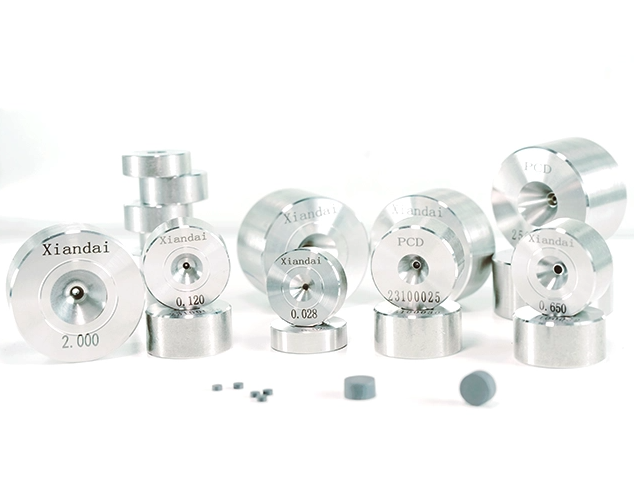
The performance of a wire drawing die largely depends on the material of its core. The core influences durability, wear resistance, surface finish, and overall drawing efficiency. Generally, wire drawing die cores fall into three main categories:
PCD Core (Polycrystalline Diamond)
CVD Diamond Core (Chemical Vapor Deposition)
Single-Crystal Diamond Core
Each core type behaves differently under high-speed drawing, extreme pressure, or elevated temperatures, and selecting the right one ensures consistent, high-quality wire production.
PCD cores are created by sintering microscopic diamond particles with a metallic or non-metallic binder under very high temperature and pressure. This process produces a strong, isotropic structure that can withstand long-term use in demanding wire-drawing operations.
Key benefits of PCD cores include:
Exceptional hardness and wear resistance, maintaining the die’s shape over thousands of meters of wire
High impact resistance, reducing the risk of cracks or chipping during production
Isotropic properties, which ensure uniform wear and prevent wires from becoming out-of-round
Cost efficiency, as PCD cores are much less expensive than single-crystal diamond alternatives while still providing excellent performance
| Feature | Benefit |
|---|---|
| Hardness | Maintains shape under high pressure |
| Wear Resistance | Long lifespan, fewer replacements |
| Impact Resistance | Reduces cracking during drawing |
| Isotropic Structure | Uniform die wear, round wires |
| Price | Lower than single-crystal diamond |
PCD cores are suitable for a wide range of metals, including copper, aluminum, stainless steel, and various alloys, making them the most widely used core type in the wire drawing industry.
CVD diamond cores are produced via chemical vapor deposition, where carbon-containing gases form a pure diamond layer on a substrate. This method creates dies with excellent hardness and high surface finish, ideal for fine wire applications.
Advantages of CVD cores:
High surface quality, producing smooth, shiny wires
Excellent thermal stability, capable of handling high temperatures
Strong corrosion resistance, suitable for aggressive environments
Limitations include:
Lower toughness compared to PCD, making them more prone to cracking under impact
Manufacturing requires strict technical control, increasing complexity and cost
| Aspect | PCD Core | CVD Core |
|---|---|---|
| Hardness | High | High |
| Toughness | Strong | Moderate |
| Thermal Stability | Moderate | High |
| Cost | Moderate | Higher |
| Typical Use | General wires | Stainless steel, fine wires |
CVD cores are ideal for stainless steel, tungsten, molybdenum, and high-precision wires, where surface finish and thermal performance are critical.
Single-crystal diamond cores are made from a single large diamond crystal, either natural or lab-grown. They are known for delivering exceptional surface finishes, especially on very fine wires.
Advantages:
Extremely hard and wear-resistant
Produces wires with superior smoothness and shine
Limitations:
Hardness is anisotropic, leading to uneven die wear over time
Rare and expensive, limiting large-scale use
Best suited for specialty applications with high surface quality requirements
Applications include:
Fine wire drawing
Premium wires requiring precision surface finish
| Feature | Single-Crystal Diamond Core |
|---|---|
| Hardness | Extremely high |
| Surface Finish | Excellent |
| Wear Uniformity | Anisotropic, uneven |
| Price | Very high |
| Typical Use | Precision fine wires |
PCD wire drawing dies are known for their exceptional lifespan. A single PCD die can last 15–25 times longer than traditional tungsten carbide dies, which means fewer replacements and less production downtime.
Reduced maintenance helps production lines run more smoothly.
Less frequent PCD die changes save time and operational costs.
High impact resistance ensures the die stays intact under pressure.
| Feature | Benefit |
|---|---|
| Lifespan | 15–25x longer than carbide |
| Impact Resistance | Reduces cracks and chipping |
| Maintenance | Less frequent replacement, lower cost |
These qualities make PCD wire drawing dies ideal for long production runs, where durability and consistency are crucial.
A major advantage of a PCD die is its ability to maintain wire quality over long runs. Its isotropic structure ensures uniform wear, so wires remain perfectly round.
Wires maintain a smooth surface finish over thousands of meters.
Prevents out-of-round wires caused by uneven wear in other die types.
Ensures tight diameter tolerances, essential for high-precision wire production.
A PCD wire drawing die reliably produces high-quality wires, even under continuous, high-speed operations.
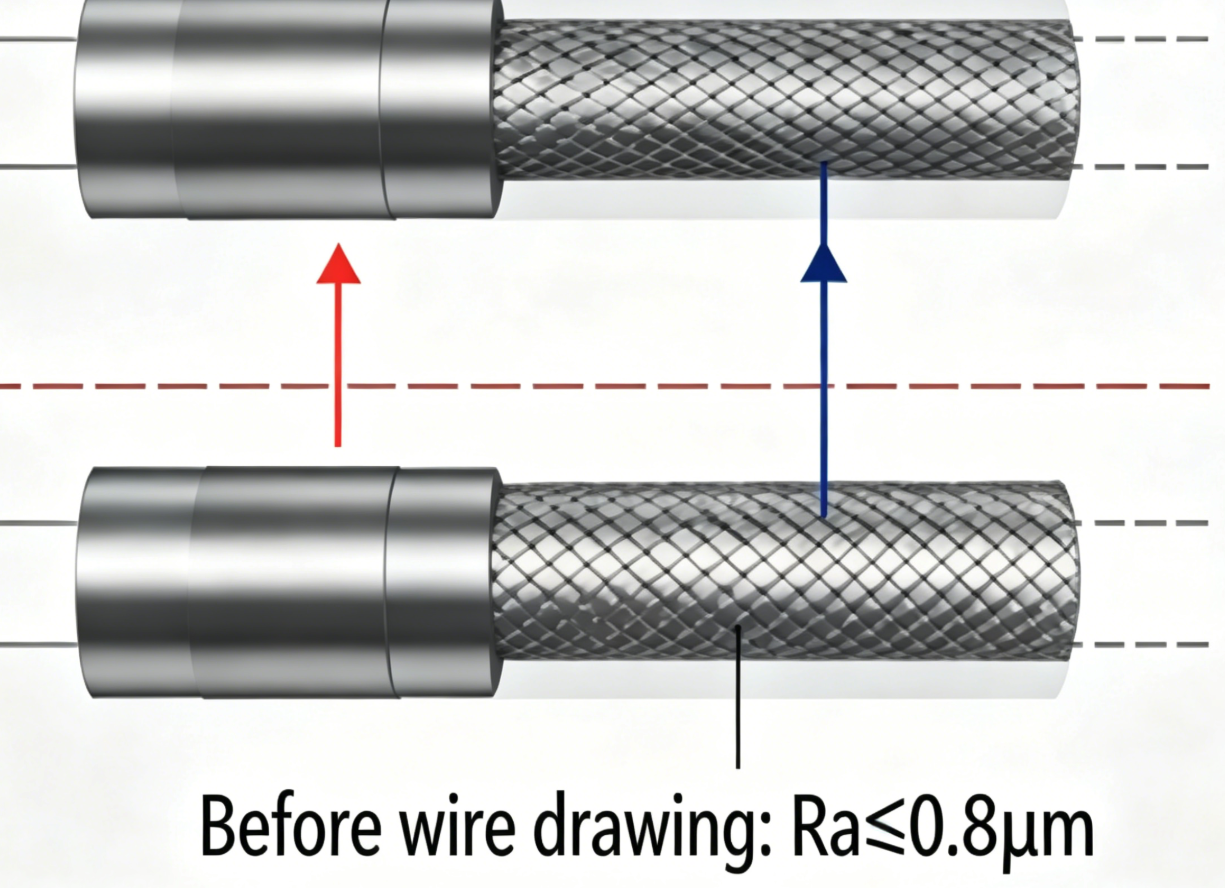
PCD dies are highly versatile and can handle a wide range of metals and wire types.
Non-ferrous metals: copper, aluminum, brass
Stainless steel, tungsten, molybdenum wires
Specialty wires: coated wires, welding wires
Suitable for both fine wires and large-diameter rods
| Metal Type | Typical Wire Applications | PCD Die Advantage |
|---|---|---|
| Copper | Electrical wiring, conductors | Smooth surface, round wires |
| Aluminum | Power lines, cables | Maintains diameter, high wear resistance |
| Stainless Steel | Springs, industrial wires | Handles tough metals |
| Tungsten & Molybdenum | EDM electrodes, specialty wires | Thermal stability |
| Coated/Welding Wire | High-performance wires | Resists corrosion |
Using a single PCD die for multiple metals reduces tooling complexity and improves operational efficiency.
PCD wire drawing dies are highly reliable even in the most challenging production environments. They perform effectively in both wet and dry drawing processes, giving manufacturers flexibility to adjust operations without compromising quality. These dies can handle cold and hot drawing conditions while maintaining their shape and precision, ensuring wires remain consistent. Thanks to their excellent thermal and corrosion resistance, PCD dies maintain stable performance even under extreme temperatures and demanding workloads.
In practical terms, this means less downtime caused by thermal or mechanical damage, more consistent wire diameters, and a smooth surface finish throughout long production runs. They also allow operations to sustain high-speed, high-temperature drawing without loss of efficiency or wire quality, making them a dependable choice for modern wire manufacturing.
| Condition | PCD Die Performance |
|---|---|
| Wet Drawing | Smooth, consistent wire output |
| Dry Drawing | Minimal friction, reduced wear |
| Cold Drawing | Maintains shape, reduces cracking |
| Hot Drawing | Thermal stability up to 1000°C |
| Corrosive Environments | Resists oxidation, keeps surface finish |
These advantages make PCD dies the go-to choice for automotive, electronics, and precision wire industries where quality and reliability matter most.
Choosing the right die can transform your wire production, and PCD wire drawing dies from NJ-ModernDiamond Co., Ltd. ensure both performance and longevity. Their unique structure keeps wires perfectly round, reduces wear, and handles both wet/dry and hot/cold drawing effortlessly. Whether you produce copper, aluminum, or high-precision specialty wires, these dies adapt to demanding conditions while minimizing downtime. Ready to upgrade your process? Explore NJ-ModernDiamond’s PCD die solutions to maximize quality, efficiency, and consistent results across every production run.
A: PCD wire drawing dies can draw copper, aluminum, stainless steel, tungsten, molybdenum, coated wires, welding wires, and various alloys, covering both fine and large-diameter wires.
A: A PCD die typically lasts 15–25 times longer than tungsten carbide dies, significantly reducing downtime and maintenance costs.
A: Yes, especially silicon-based PCD cores, which maintain stability up to 1000°C, while cobalt-based cores are suitable below 650°C.
A: PCD dies are isotropic, durable, and cost-effective; CVD dies offer high surface finish and thermal resistance but lower toughness; single-crystal dies provide exceptional finish but uneven wear, high cost, and rarity.
A: Use single-crystal or CVD dies for ultra-fine wires needing high surface quality; PCD dies suit both fine and thick wires due to durability, uniform wear, and cost-efficiency.