Views: 0 Author: Site Editor Publish Time: 2026-03-20 Origin: Site
The working principle of each area of the PCD die is key to achieving stable, high-quality wire production. Ever wondered why some wires show perfect surface finish while others fail? It often comes down to the PCD die structure. In this guide, we break down how each zone—entrance, lubrication, working, sizing, and exit—functions together. You’ll learn how PCD die geometry, lubrication control, and deformation behavior directly impact performance, efficiency, and die life.
PCD drawing dies may appear simple externally, but their internal structure is highly engineered. Inside the die core, a precisely designed hole profile controls how the wire enters, deforms, and exits. This profile is not uniform. Instead, it is divided into multiple functional zones, each contributing to the overall drawing performance. The core itself typically consists of a polycrystalline diamond (PCD) layer bonded to a supporting substrate, offering high hardness, wear resistance, and dimensional stability.
The internal geometry of a PCD drawing die is designed as a continuous path for the wire. It allows smooth transition from entry to exit while controlling friction and deformation. We can think of it as a guided channel where the wire is gradually reduced in size under controlled conditions. Each section has a specific role, and together they determine the efficiency and quality of the wire drawing process.
A standard PCD drawing die consists of five main functional areas:
| Area Name | Function | Design Focus |
|---|---|---|
| Entrance Area | Guides wire into the die | Smooth entry, prevent damage |
| Lubrication Area | Supplies and distributes lubricant | Flow efficiency, angle control |
| Working Area | Performs diameter reduction | Controlled deformation |
| Sizing Area | Ensures final dimensions | Precision and stability |
| Exit Area | Releases wire from the die | Reduce friction, avoid scratches |
Entrance Area helps the wire enter smoothly. It reduces initial contact stress and prevents surface damage.
Lubrication Area stores and directs lubricant into the deformation zone. It plays a key role in minimizing friction.
Working Area is where plastic deformation happens. Here, the wire diameter is reduced to the target size.
Sizing Area stabilizes the wire and ensures dimensional accuracy. It maintains consistency in diameter and roundness.
Exit Area allows the wire to leave the die with minimal resistance, protecting the final surface quality.
During operation, the wire passes through each zone in sequence. First, it enters the die through the entrance area, where alignment begins. Then, it moves into the lubrication zone, where lubricant is introduced and distributed evenly. After that, the wire enters the working area, where compressive forces reduce its diameter through plastic deformation.
Next, the wire passes through the sizing area, where its final dimensions are stabilized. This section ensures accuracy and prevents dimensional fluctuation. Finally, the wire exits through the exit area, where contact is minimized to avoid surface damage. This process is continuous. Each zone depends on the previous one. If lubrication is insufficient, deformation becomes unstable. If sizing is incorrect, the final wire quality suffers.
The geometry of the die directly affects how the wire behaves during drawing. Parameters such as angle, length, and transition between zones influence drawing force, friction, and material flow. A smaller angle may increase friction but improve control, while a larger angle reduces resistance but may lead to instability.
The length of each zone also matters. Longer working or sizing areas improve stability and precision, while shorter ones may increase speed but risk defects. Proper design balances drawing force, surface quality, and die life. In practice, optimizing die geometry allows smoother deformation, better lubrication conditions, and longer service life. It ensures that the wire maintains consistent dimensions and high surface quality throughout the drawing process.
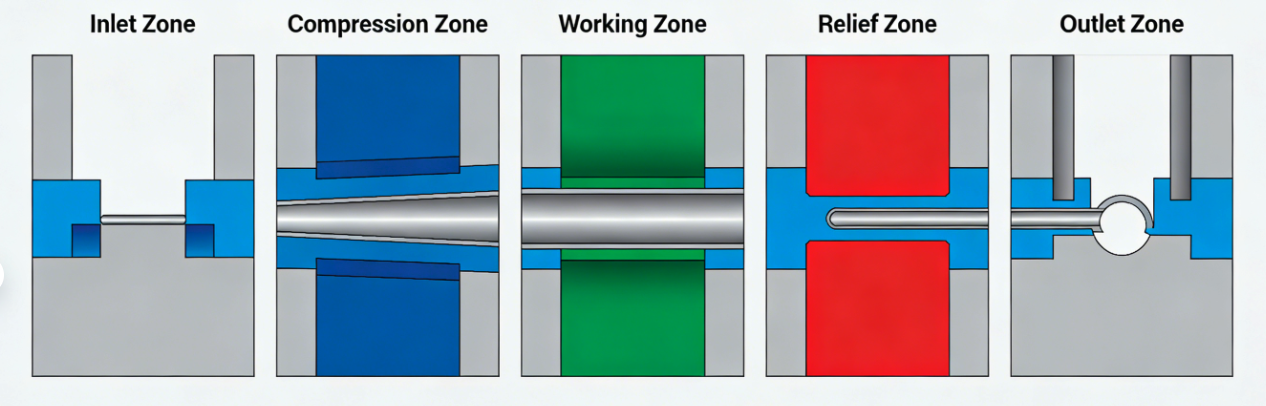
Understanding each zone helps us control quality and efficiency. Each section plays its own role, yet they must work as a system.
The entrance area is the first contact point for the wire. It guides the wire into the die smoothly and prepares it for the next stages. A well-shaped entrance reduces impact and avoids sudden friction. The working principle here is simple. It aligns the wire and creates a smooth transition into the lubrication zone. The entrance angle matters a lot. If it is too sharp, the wire may scratch. If too large, control becomes weak. It also helps lubricant access the surface early. This improves flow before deformation begins. Designers often focus on smooth curvature, stable entry position, and minimal contact stress.
Common issues from poor design include:
Surface scratching at entry
Wire misalignment
Unstable feeding into the die
The lubrication area acts as a storage and delivery zone. It holds lubricant and directs it toward the working area. Without it, friction rises quickly. Its working principle relies on pressure buildup. As the wire moves forward, lubricant gets compressed slightly. This helps form a thin film before deformation starts.
Several factors affect its performance:
Lubricant viscosity → thicker fluids need larger angles
Wire diameter → larger wires need more lubricant volume
Cone angle and length → control flow speed and pressure
A properly designed zone improves lubrication efficiency. It reduces wear and heat generation.
Common problems include:
Poor lubricant flow
Dry friction zones
Uneven lubrication film
Simple solutions involve adjusting angle, length, or lubricant type.
This is where real deformation happens. The wire diameter reduces step by step as it passes through this zone. Material flows under compressive stress. The working principle is based on plastic deformation. The wire changes shape permanently. It must stay centered during this process. Concentricity between wire and die hole is critical. If alignment shifts, problems appear quickly. The wire may deform unevenly or develop defects. Wear also plays a role. After repeated use, the inner hole may enlarge. This reduces control and affects final size. Designers usually extend this zone slightly. The working length should be longer than the actual deformation region. This ensures stable reduction and smoother flow.
Key effects include:
Drawing force variation
Surface finish quality
Dimensional consistency
The sizing area defines the final diameter. It stabilizes the wire after deformation. This zone ensures accuracy and repeatability. Its working principle is based on controlled contact. The wire passes through a fixed diameter section. It corrects small deviations and smooths the surface.
Length plays a critical role here.
Too short → wire may vibrate or shake
Too long → friction increases and heat builds up
Elastic recovery also affects results. After deformation, the wire slightly springs back. The sizing diameter must consider this behavior.
Common problems include:
Surface defects or roughness
Size deviation from tolerance
Faster wear of the die
Best practices include:
Keep the zone straight and uniform
Optimize length based on material
Balance friction and stability
The exit area is the final stage. It allows the wire to leave the die smoothly. Contact reduces quickly in this section. The working principle is based on clearance design. After sizing, the wire should not rub against the die wall. This prevents scratches and surface damage. A right-angle or relief structure is often used. It helps release the wire cleanly. It also reduces unnecessary friction after sizing.
Benefits of a proper exit design:
Lower risk of surface defects
Improved wire stability after خروج
Reduced wear on the die
It also helps maintain die geometry over time. Less contact means less damage.
| Area | Main Role | Key Risk if Poorly Designed |
|---|---|---|
| Entrance | Guide wire | Scratching, misalignment |
| Lubrication | Deliver lubricant | Dry friction, wear |
| Working | Deform wire | Size inconsistency |
| Sizing | Final dimension control | Vibration, defects |
| Exit | Smooth release | Surface damage |
Understanding how each zone of a PCD die functions gives you more control over wire quality and production efficiency. When you optimize entrance alignment, lubrication flow, and deformation balance in your PCD die, results improve across the board. Small design changes in the PCD die can make a big difference in die life and consistency.
If you’re looking to upgrade performance, working with experts like NJ-ModernDiamond Co., Ltd. can help. Their advanced PCD die solutions are designed for precision, durability, and high-speed applications—helping you stay competitive in demanding manufacturing environments.
A: The working area is the most critical. It controls plastic deformation and directly affects wire size, surface quality, and drawing force.
A: It reduces friction and heat. Good lubrication improves surface finish, lowers wear, and allows stable high-speed drawing.
A: It ensures stable deformation. Extra length helps maintain alignment and prevents uneven reduction.
A: Too short causes vibration and size errors. Too long increases friction and accelerates die wear.
A: Use straight-line designs. They improve lubrication, reduce wear, and support higher drawing speeds.