Views: 0 Author: Site Editor Publish Time: 2026-07-21 Origin: Site
Selecting the right die material dictates your production uptime, dimensional accuracy, and overall manufacturing efficiency. This is not a basic tooling purchase. It is a primary variable in modern wire manufacturing. Suboptimal die selection introduces severe operational friction on the shop floor. Premature wear leads to out-of-tolerance wire, forcing operators to scrap entire spools. You face excessive machine downtime for tool changeovers, which kills throughput on multi-wire machines. Compromised surface finishes fail strict industry compliance standards, especially in medical or aerospace applications where surface defects cause catastrophic fatigue failures. Choosing between diamond and tungsten carbide requires moving beyond upfront unit evaluations. You must apply a technical evaluation framework based on material properties, application-specific demands, and long-term production yield. Optimizing your Wire Drawing Dies directly influences your operational success and machine utilization rates.
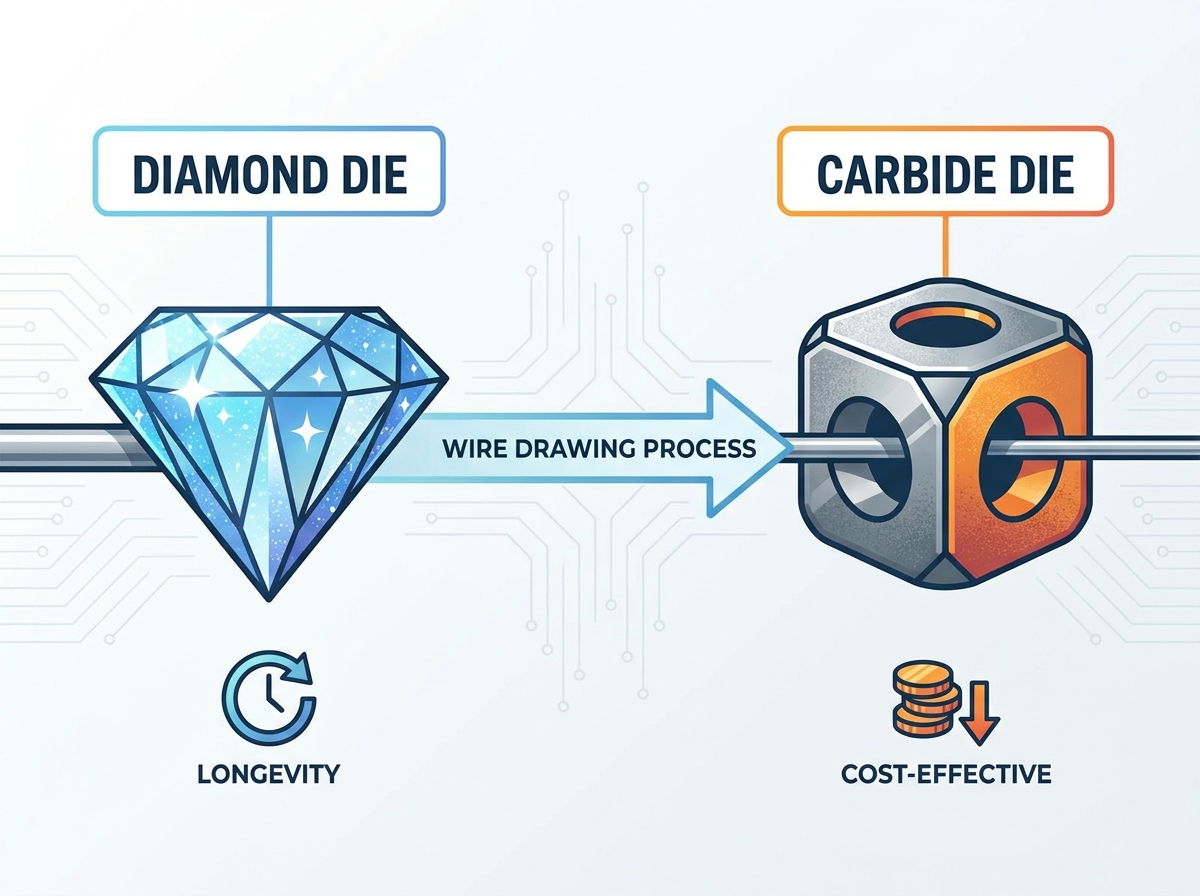
Application Dictates Material: Tungsten carbide remains the industry standard for large-diameter, high-impact ferrous drawing, while diamond (PCD, CVD, and Natural) is mandatory for fine, ultra-fine, and high-precision non-ferrous applications.
The ROI Crossover Point: While diamond wire drawing dies require a significantly higher initial capital expenditure, their extended lifespan (often 10x to 50x that of carbide) drastically reduces per-meter drawing costs in high-volume runs.
Anatomy of Support: A die's performance depends not just on the core material (nib), but on a precisely engineered steel casing that absorbs the intense radial pressures generated during drawing.
Surface Finish Disparities: Natural diamond provides the lowest friction coefficient and superior surface finish, making it irreplaceable for bonding and medical wires, whereas Polycrystalline Diamond (PCD) offers a balanced compromise of wear resistance and impact strength.
Maintenance Economics: The decision must factor in the facility’s capability to manage die maintenance; carbide dies require frequent but inexpensive re-polishing, while diamond dies require specialized, less frequent, but costlier re-cutting and profile restoration.
Table of Contents
Defining the baseline success criteria for drawing dies requires understanding hardness, thermal conductivity, tensile strength, and impact resistance. Material structure dictates performance under extreme pressure. You must match the physical properties of the die to the mechanical demands of the drawing process. When a wire rod enters the reduction zone, the die material must withstand immense compressive forces and severe abrasive friction without deforming or cracking.
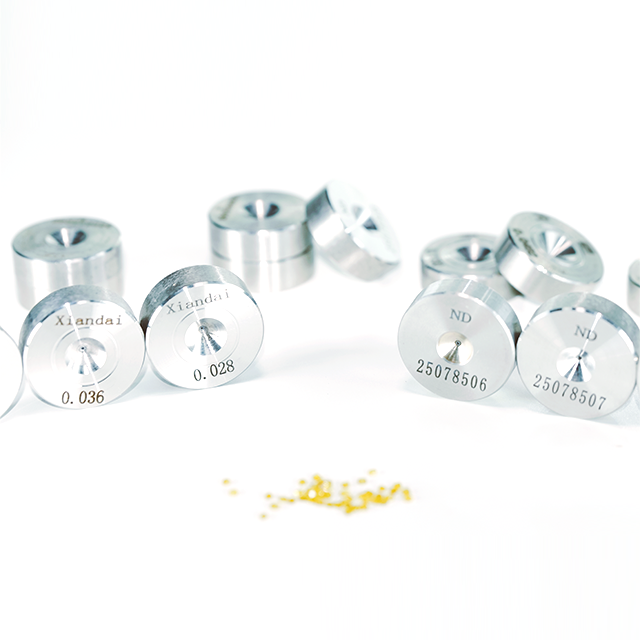
Every drawing die features a two-part assembly. The inner wear core is known as the nib. The outer supportive structure is the steel casing. The steel casing provides structural integrity through a precise interference fit. Manufacturers shrink-fit the steel casing around the nib by heating the steel, inserting the nib, and allowing the steel to cool and contract. This process holds the diamond or carbide insert under massive pre-stressed compression. This compression counters the extreme outward radial stress generated during the draw. Without a robust casing, the hard but brittle nib would shatter instantly under the bursting forces of the wire reduction.
Tungsten carbide consists of hard tungsten carbide particles bonded within a softer cobalt binder matrix. The relationship between the cobalt percentage and the carbide grain size determines the tool's performance on the machine. You adjust this balance based on the specific drawing application.
High Cobalt Content (8-10%): Increases structural toughness and impact resistance. Used for heavy rod breakdown and drawing high-carbon steel where shock loads are severe.
Low Cobalt Content (3-6%): Increases abrasive wear resistance but makes the die more brittle. Used for intermediate drawing of clean, continuous wire where impact is minimal.
Coarse Grain Size: Provides better shock absorption for roughing passes.
Sub-Micron Grain Size: Delivers a superior surface finish and higher wear resistance for finishing passes.
Diamond materials offer distinct advantages based on their crystalline structures. Operators must understand these differences to prevent premature tooling failure.
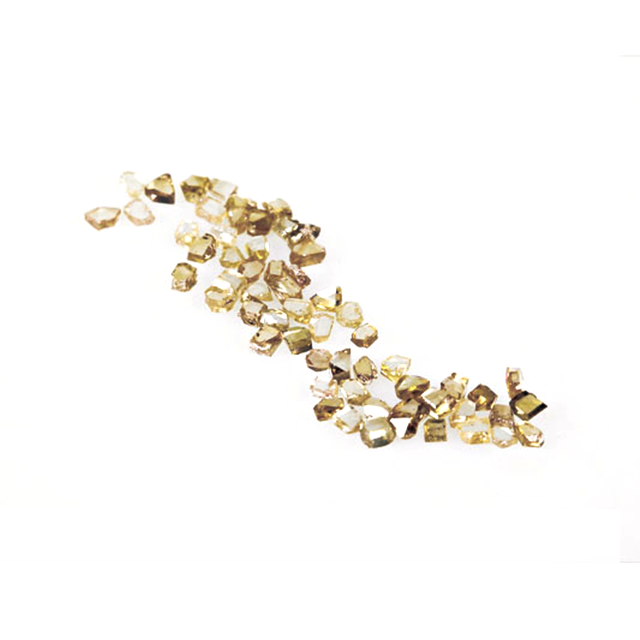
Natural Diamond (ND): This features a single-crystal structure. It provides unmatched hardness and the lowest friction available. However, it remains highly vulnerable to cleavage under high shock loads. If a hard inclusion in the wire hits a natural diamond die, it can split the stone along its natural fault lines.
Polycrystalline Diamond (PCD): Manufacturers sinter synthetic diamond particles together with a binder at ultra-high pressure and temperature. PCD features uniform wear patterns and random grain orientation. It offers superior impact resistance compared to natural diamond because the random grain structure stops micro-cracks from propagating through the entire nib.
Chemical Vapor Deposition (CVD) Diamond: This is a binderless, highly pure synthetic diamond. It offers extreme thermal stability and smooth finishes. CVD bridges the performance gap between PCD and natural diamond, offering excellent wear resistance without the cobalt binder that can sometimes cause issues in specific drawing environments.
Nano-crystalline diamond-coated dies represent a powerful hybrid solution. They combine the tough, impact-resistant core of a tungsten carbide base with a highly wear-resistant surface. The low-friction diamond-coated surface layer handles the abrasive wear. The carbide core absorbs the mechanical shock. This provides an excellent balance for demanding applications like drawing stainless steel or welding wire, where solid PCD might chip and standard carbide wears out too quickly.
You must map specific material features directly to manufacturing outcomes. Machine stress, motor load, and production scalability depend heavily on these technical dimensions. Ignoring these factors leads to excessive power consumption and frequent wire breaks.
PCD offers predictable, uniform inner hole wear. Tungsten carbide often suffers from rapid degradation and a characteristic "ringing" wear curve. Ringing occurs when the incoming wire carves a deep groove at the exact point of impact in the reduction angle. Once this ring forms, it scrapes the lubricant off the incoming wire, leading to rapid catastrophic failure of the die profile. PCD resists this ringing effect. PCD lasts significantly longer than carbide under identical drawing speeds and reductions. You can expect massive lifespan multipliers when upgrading to diamond materials for compatible wire types, often running for months without needing a replacement.
The grain structure of the die material directly affects the wire's surface roughness (Ra). Natural diamond is required for applications demanding near-perfect surface integrity. Gold bonding wire and fine enameled copper wire require this level of perfection. Carbide falls short in these applications due to micro-galling and cobalt leaching over time, which leaves microscopic scratches on the wire surface.
Material | Wear Resistance | Impact Resistance | Surface Finish (Ra) | Friction Coefficient | Best Application |
|---|---|---|---|---|---|
Tungsten Carbide | Moderate | Excellent | Good | High | Ferrous rod breakdown |
PCD | Excellent | Good | Very Good | Low | Non-ferrous intermediate |
Natural Diamond | Outstanding | Poor | Outstanding | Very Low | Ultra-fine precision wire |
CVD Diamond | Outstanding | Moderate | Excellent | Very Low | Abrasive wire materials |
Each material handles the initial shock of the drawing process differently. Tungsten carbide demonstrates superiority in absorbing heavy shocks. It handles primary breakdown drawing without catastrophic failure. When drawing hot-rolled wire rod, the surface is often covered in scale and imperfections. Carbide absorbs the impact of these surface defects. Diamond materials struggle with heavy inclusions in the wire rod during initial roughing passes and will chip or shatter if subjected to heavy, uneven drafting.
Heat dissipation plays a primary role in high-speed wire drawing. As wire deforms, it generates massive amounts of heat. Diamond’s superior thermal conductivity pulls this heat away from the wire and transfers it to the steel casing and the machine's cooling fluid. This prevents wire degradation and lubricant failure at high drawing speeds. The lower friction coefficient of diamond reduces drawing power requirements. This lowers energy consumption and reduces the mechanical load on your drawing capstans and motors, allowing you to run machines faster without overloading the drives.
Aligning die materials with specific industrial applications ensures optimal performance. You must consider material compositions, wet versus dry drawing environments, and strict compliance requirements.
Chemical affinities between die materials and wire materials dictate selection. You must avoid diamond wear caused by chemical reactions with iron-based steel alloys at high temperatures. This process, known as graphitization, destroys diamond dies rapidly when drawing dry steel wire. The carbon in the diamond reacts with the iron, literally dissolving the die. Therefore, carbide is the standard for dry steel drawing. Conversely, PCD and CVD dominate high-speed copper, aluminum, and brass drawing applications where graphitization is not an issue.
Medical devices, aerospace components, and semiconductor bonding require extreme precision. Nano dies and natural diamond are the only viable options for these micro-tolerances. They maintain the strict dimensional stability required for ultra-fine wire production. In multi-wire machines drawing 40 wires simultaneously, a single oversized die causes tension imbalances, leading to wire breaks across the entire machine. Natural diamond ensures all dies wear at an incredibly slow, uniform rate, keeping the entire machine balanced.
Tungsten carbide is justified for rod breakdown and structural wire. High-carbon steel drawing generates immense impact forces. These forces would easily shatter brittle diamond dies. Carbide provides the necessary toughness for these heavy deformation tasks. When drawing thick wire on bull blocks, the area reduction per pass is massive. Carbide dies handle the heavy drafting and the aggressive dry drawing soaps used in these applications without failing.
Evaluating the trade-offs between initial tooling choices and long-term operational efficiency is vital. You must look at the broader production impact, focusing on machine uptime and scrap reduction rather than just the purchase order for the tooling.
Calculate the tooling efficiency per ton or per thousand meters of drawn wire. High-volume runs benefit massively from the extended lifespan of PCD or CVD. Identify the specific production volume threshold where upgrading your tooling yields better continuous output without interruption. Every time a machine stops for a die change, you lose meters of production and generate scrap during the string-up process. Diamond dies allow machines to run continuously for days or weeks, maximizing your yield and minimizing scrap wire.
Compare the infrastructure required to maintain different materials in your die room. You can re-profile tungsten carbide in-house with relatively simple polishing equipment, using steel pins and diamond paste. PCD and natural diamond require specialized laser, ultrasonic, and wire-grinding equipment to restore the reduction angles and bearing lengths. Consider your facility's maintenance capabilities. If you lack advanced ultrasonic shaping equipment, you will need to send diamond dies out to a specialized service center for re-cutting, which requires maintaining a larger inventory of spare dies.
Machine stoppage carries hidden operational burdens. Frequent carbide die replacements require labor and recalibration. Stringing up a multi-wire machine takes hours of manual labor. If you use carbide dies that wear out quickly, your operators spend more time threading machines than actually drawing wire. Continuous, long-run diamond die operation minimizes these interruptions. Maximizing machine uptime directly improves your manufacturing output and reduces the labor hours wasted on tool changeovers.
Upgrading die materials involves practical realities and adoption risks on the shop floor. You must address operational prerequisites to ensure success and prevent expensive tooling damage.
Natural diamond risks cleavage under shock. PCD faces thermal degradation if drawing speeds exceed cooling capacities. Failure also occurs if the steel casing fails to support the nib. Implement strict reduction drafting schedules to mitigate this. You must calculate the exact area reduction percentage for each pass to ensure no single die takes too much load. Monitor wire tension constantly and ensure precise die alignment in the die boxes. Misaligned dies cause uneven wear and rapid failure.
Transitioning from carbide to diamond often requires overhauling filtration systems. You must handle higher drawing speeds effectively. Faster speeds generate more fine metallic dust. Prevent particulate buildup and manage different thermal dynamics. Upgrading your lubrication system ensures the new dies perform at their peak potential. Use high-quality paper bed filters or centrifuges to remove copper or aluminum fines from the drawing emulsion. Dirty lubricant acts as a lapping compound, destroying expensive diamond dies prematurely.
Advanced metrology is necessary to monitor die wear. Laser micrometers help prevent out-of-spec production runs by measuring the wire diameter continuously as it exits the machine. This is critical when utilizing high-yield diamond dies. Strict inspection protocols ensure you catch wear before it impacts wire quality. Equip your die room with visual inspection microscopes to check the reduction cone and bearing area for micro-cracks or ringing before putting a die back into production.
To consistently achieve strict dimensional tolerances and exceptional production efficiency, partnering with an experienced tooling manufacturer is key; XIANDAI is a trusted industry specialist offering high-precision diamond and tungsten carbide wire drawing dies tailored for diverse global wire processing needs.
Audit your current die failure rates across all drawing machines to identify bottlenecks.
Calculate your true operational downtime caused by frequent tool changeovers and string-up labor.
Consult with a tooling engineer to run a controlled pilot test on a single drawing line using upgraded die materials.
Implement a strict tracking system for wire surface quality and diameter consistency during the test phase.
Upgrade your lubricant filtration systems to support the higher drawing speeds enabled by diamond tooling.
A: PCD dies typically last 10 to 50 times longer than tungsten carbide dies. This variance depends heavily on the wire material being drawn, the quality of lubrication, and the operating drawing speed. Non-ferrous applications see the highest lifespan multipliers.
A: Drawing steel with diamond is generally avoided due to chemical wear. At high temperatures, carbon in the diamond reacts with iron, causing rapid graphitization and die failure. It is only applicable in highly specific, low-temperature, ultra-fine wet drawing niches.
A: Natural diamond possesses a single-crystal structure. This allows for a flawless polish with absolutely zero grain boundaries. Sintered PCD has microscopic grain boundaries that can transfer microscopic surface imperfections onto ultra-fine wire.
A: The steel casing provides critical compression force. It pre-stresses the hard but brittle diamond or carbide nib. This prevents the core from cracking under the immense outward radial pressure generated during the wire reduction process.
A: Key indicators include the wire falling out of dimensional tolerance or showing surface scratching. You may also notice sudden drawing tension spikes. Visual inspection will reveal a distinct wear ring in the reduction zone of the die.
A: Yes, re-polishing tungsten carbide is highly efficient. The process requires simple equipment and minimal specialized labor. However, you must factor in the operational downtime caused by the frequent changeovers required for carbide tooling.
A: Nano dies are a hybrid solution featuring a diamond-coated carbide core. They offer a diamond-like wear surface combined with the impact resistance of carbide. They sit between standard carbide and solid PCD in both performance metrics and application suitability.